Friends
  • Amsterdam marijuana seeds Cheap cannabis seeds. Get 20 seeds for free with each order. Limit OFFER
  • Cannabis seeds review Review cannabis, weed seeds. Buy marijuana seeds online
  • Seedsman Our aim is to provide the finest quality cannabis seeds at the lowest prices. Discount Code is SD4886 with each order
  • Sensi Seeds bank Sensi Seed Bank varieties are the product of the very finest cannabis genetics for over 20 years

New UK Government’s drug adviser Les Iversen seems to have a selective memory

Les Iversen wanted cannabis legalisedAnother crazy news story from the UK. As you might have read on this blog, David Nutt was sacked because of him criticizing the Government’s decision to reclassify cannabis as a Class B substance.. He argued that the scientific research was devaluated and the UK government making an “artificial” separation of alcohol and tobacco from illegal drugs.

If you thought that was strange, wait until you hear this.. The new chairman that will replace David Nutt, Les Iversen, had exactly the same opinion with regards to Cannabis. During a lecture in 2003 he said the following;

“There have been no deaths to date caused by use of cannabis. Cannabis should be legalised, not just decriminalized, because it is comparatively less dangerous than legal drugs like alcohol and tobacco.”

In an article in 2003 he wrote that cannabis had been incorrectly classified for nearly 50 years as a dangerous drug and that it was one of the “safer” recreational drugs.

When he was questioned about these remarks during an interview on BBC Radio 5 Professor Iversen stated the following; “I don’t remember saying that. It’s certainly not my position now”

“We have now to confront the more potent forms of cannabis. We have the new evidence that arose since 2003 linking cannabis to psychiatric illness. I think it’s quite free for a scientist to change his mind when faced with new facts.”

We wonder what these new facts are? Is it the fact that he will get sacked, like David Nutt,  if he says that cannabis should be legalized? Or the fact that he would never have been appointed in the first place if he still had that opinion?

Sensi Seeds Skunk#1 winner of the oldest spanish cannabis cup!

The AMEC cannabis Cup (Asociacion Madrilena de Estudios de Cannabis) is the oldest cannabis festival in Spain. The last cup was already the 13th edition of this spanish cannabis cup!

The overall winner was Skunk #1, from Sensi Seeds. This was also the winner in the categories Presence (appearance) and taste. The plant was grown outdoors (in a pot) from April till early October, and she was feed with “Organic Bloom and loads of love, at the mountains of Guadalajara”.

The second and third prize went to respectivly Shark Attack and Critical +.

Cannabis legal in the Czech Republic?!

Legalize-cannabisThe Czech Republic is bringing in some very interesting legislation in 2010.

From January 1st, individuals in possession of 15 grams of cannabis or less will not be charged with a crime in the Czech Republic. The new laws, which decriminalize the possession of ‘small amounts’ of most currently illegal drugs, are based on a  Justice Ministry proposal which was approved by the Czech government earlier this month.

Previously, there were few clear definitions of what level of drug possession was treated as ‘small’, since standards were based on internal police directives and could change from region to region. The new legislation clearly defines how much of each substance is considered a ‘small amount’ under the law. Individuals in possession of this amount or less will not be charged with a crime.

Additionally, the new laws seem to make it possible for individuals to grow up to five cannabis plants. However, if current Dutch legislation is anything to go by, this may not necessarily include indoor growing with lamps, nor allow households with several adults to grow five plants each.
In any case, this new legislation is a big step in the right direction and we hope that other European countries will be inspired by the Czech move towards a sane drug policy.

Rick Simpson – Freedom Fighter of the Year 2009

Rick Simpson cannabis oil medicinal marijuanaLast week during the High Times Cup 2009, Rick Simpson was awarded with the title Freedom Fighter Of The Year 2009. We feel that Rick Simpson is one of the people that truly deserves this title.

That is why we feel it is important to tell as many people as possible about this remarkable man and his fight for Medical Marijuana. Mr. Simpson claims that his pure cannabis oil can cure all kinds of diseases and even cancer. The Canadian government does not believe this and have tried to prosecute him as a drug dealer in the past even though his only crime is giving it away for free to terminally ill cancer patients. We don’t get this… Even if you do not believe him, what harm is there to have terminally ill cancer patient try this medicine?

Below you’ll find a short statement on recent events from Rick Simpsons website phoenixtears.ca

On November 25th, 2009, one day before I was crowned the Freedom Fighter of the Year 2009 at the Cannabis Cup in Amsterdam, I received a word that I have been raided again by the RCMP. I contacted Tim Hunter at the Amherst attachment and asked I was being charged. Of course, he refused to give me straight answer. All he would say was that the RCMP wanted to talk to me.

After openly growing hemp in my backyard this past summer and announcing this fact to the public on tom Young?s open line talk show in June, how could the RCMP not be aware of my activities? The truth is they knew exactly what I was doing. RCMP officers were even sending people that needed help to me. I can only surmise that the purpose of this raid was to keep me from returning to Canada.

If I return home, I will be arrested and put in jail without bail or medicine. I am not afraid of their jails but I cannot go without my medicine, the system has nothing that could help me with my conditions. So for me to return to Canada would be like committing suicide. I would be thrown in jail and denied my medicine and a short time later you would hear in the news that Rick Simpson died of natural causes. I cannot tell the people of Canada who are depending on my presence to help their medical conditions how sorry I am. But it was not me who caused this situation.

Cannabis oil a cure for Parkisons disease?

Posted in Cannabis News, medicinal, Society and Cannabis Tagged: Canada, cancer, Cannabis Oil, medical marijuana, medicine, Parkisons disease, RCMP, Rick Simpson, THC

The Super-Marijuana “Kush/Skunk” story

In the US, it seems that the word ‘Kush’ is about as meaningful as ‘Skunk’ is in the UK.

That is, the two terms are applied to most indoor weed that’s sold for profit, and both names are used to suggest that the cannabis being sold is highly potent, rather than to indicate any particular genetic heritage. Before being adopted as the strain-name buzzwords of the moment, both “Skunk” and “Kush” were fairly strictly defined strains, with clear breeding or geographical origins.

More worryingly, when the buzzwords of the youth or underground cultures seep into the mainstream, they get picked up by the hysterical MSM and turned into the latest scare story.

No doubt, all of the forum’s British members will be aware of the garbage that’s written and broadcast about “Skunk” in Blightly – as if it’s some new, child-incinerating super-weed that just dropped out of the sky, rather than a fairly common, medium-to-high potency strain that’s been around for at least 30 years.

What’s especially nauseating about this claim what it tacitly suggests. Most members of the current establishment (government and media) have personal experience of consuming cannabis, in their ‘experimental student days’ or whatever. The subtext of the “new, super-potent weed” claim is that, in hindsight, the harmless old ‘natural’ cannabis of their youth was actually fine after all (as was the hashish of the times, apparently, despite it being orders of magnitude more powerful than today, but that’s another story).

No matter that thousands were deprived of their liberty due to the draconian laws covering old-timey, harmless ‘natural’ cannabis in the 60s and 70s, it turns out that version of the demon weed was fine and harmless. Mistakes were made.
But this new “Skunk” weed … that really does live up to all the fantasies that were spread back then, about the stuff we now know to be harmless.

Anyway, it seems American prohibitionists have embraced the tactic of defining slightly more potent cannabis as a different drug deserving of even greater and more ridiculous penalties

As might be expected, US lawmakers have taken it to the next level.

Kirk and Law Enforcement: Super-Marijuana “Kush” Hits Suburbs
Monday, 15 June 2009

CHICAGO – U.S. Rep. Mark Kirk, Lake County Metropolitan Enforcement Group Director Larry Lindenman, Waukegan Police Chief Artis Yancey and representatives from Lake County Sheriff Mark Curran’s office today unveiled tougher penalties for a new type of “super-marijuana” hitting the northern suburbs.   “Kush,” street slang for a strain of highly-potent marijuana, has a tretrahydrocannabinol (THC) content of at least 20 percent.  According to the National Drug Intelligence Center, the THC average of seized marijuana was less than 10 percent in 2007.  In the early 1990s, THC levels were less than 4 percent.

“According to the National Survey on Drug Use and Health, more than 25 million individuals age 12 and older used marijuana in 2007 – significantly more than any other drug,” Congressman Mark Kirk said.  “That’s why Kush and other high-potency marijuana strains are so worrying.  Local law enforcement reports that Kush users are ‘zombie-like’ because of the extreme THC levels.  Drug dealers know they can make as much money selling Kush as cocaine but without the heavier sentences that accompany crack and cocaine trafficking.  Higher fines and longer sentences aren’t the total solution to our nation’s drug problem.  But our laws should keep pace with advances in the strength and cash-value of high-THC marijuana.  If you can make as much money selling pot as cocaine, you should face the same penalties.”

The rise of Kush mirrors the increasing popularity of high-THC marijuana, which has become more accessible with the rise of hydroponics.  Drug growers are able to strictly control light, temperature and humidity and can cross-breed to maximize THC content.  It takes growers approximately four months from planting to harvest to produce the high-potency marijuana.  Other types of Kush are known as Bubba, Paris, Bubble Gum, Sour and Orange Kush.

According to the U.S. Drug Enforcement Administration, Kush has been known to sell for as high as $600 per ounce – creating the same profit potential as crack cocaine. (Er.. really?)

Kirk’s legislation, the High-Potency Marijuana Sentencing Enhancement Act of 2009 (H.R. 2828), increases federal fines and sentences for the distribution of high-potency marijuana.  It defines high-potency marijuana as marijuana with a THC content of 15 percent or more.  The legislation targets drug trafficking only and not possession of marijuana.

Under current law, unlawful distribution, possession with intent to distribute, manufacture, importation and exportation of marijuana under 50 kilograms or 1 to 49 plants carries a maximum fine of $250,000 for an individual, $1 million for a group and up to five years in prison.  H.R. 2828 increases maximum fines to $1 million for an individual and $5 million for a group, with a maximum sentence of 25 years.  If death or serious bodily injury occurs, sentencing would be 20 years to life in prison.

A second offense after a drug felony conviction would result in a minimum fine of $2 million for an individual or $10 million for a group, with a maximum sentence of 35 years, or life if death or serious bodily injury resulted from the use of the marijuana.

Source: kirk.house.gov

And what a coincidence, that as medicinal cannabis laws are sweeping the USA (13 states and counting), the cannabis most valued for medicine – potent, well-grown sinsemilla – is being defined as an even harder drug than before.
Don’t forget that cannabis is a Schedule I (Class A) drug in the US…

Posted in cannabis lies, Quotes & Opinions Tagged: buzzwords, Drugs law, kush, National Drug Intelligence Center, sinsemilla, skunk, super-weed, THC

Ex-U.S. attorney: Time to change pot laws

Three years ago, former U.S. Attorney John McKay was somewhere near the front lines of the nation’s drug war.

Directing federal prosecutions in Western Washington before he was fired in 2006 by the administration that appointed him, McKay’s office sent marijuana smugglers and farmers to prison on decade-long terms. It indicted a loudmouth Canadian pro-pot activist for selling cannabis seeds by mail order.

So the crowd at an Edmonds auditorium could have been forgiven its surprise on Monday when McKay stood on stage with travel author and decriminalization advocate Rick Steves and declared that, of course, he is “against stupid laws.”

“I think there has to be a shift in the paradigm,” said McKay, now a professor at Seattle University. “The correct policy change would be a top-to-bottom review of the nation’s drug laws.”

McKay joined a panel as part of an effort by Steves and the American Civil Liberties Union to, in their view, return rationality to discussions about the nation’s drug laws. They were joined there by Egil “Bud” Krogh, a former official in the Nixon White House who gained notoriety during the Watergate scandal, and state Rep. Mary Helen Roberts, an Edmonds Democrat who joked Monday about being dubbed by her colleagues the “Marijuana Queen of Northwest Washington” for her efforts on medical marijuana law reform.

While the panelists did not agree on all points, each said they see the need for substantive change in the way marijuana is regulated and offenders are punished. They also each spoke about the fears, or lack of courage, of elected officials in addressing issues surrounding the drug.

Steves and the ACLU launched the initiative last year partly as a response to that fear. The effort, built around an infomercial “Marijuana: It’s Time for a Conversation,” is aimed at encouraging citizens to discuss the issue openly.

“This is an issue that’s scary for people,” Steves said. “I have friends who oppose what I do on this issue because they’re worried about their kids. What they don’t understand is that so are we.”

Addressing the audience, a group mixed in age and outward appearance, Roberts argued that the law as it stands takes an unjust toll on minority communities. In essence, she said, it leaves law enforcement agencies to pursue people who are easiest to catch while their efforts could be more productively spent elsewhere.

At the same time, she said, lawmakers — even those who believe the laws to be unjust with regard to marijuana — are afraid of being branded soft on crime.

“As a community and a society, we’re afraid of crime,” Roberts said. “And if what you’re doing is being referred to as ’soft on crime,’ even without details, legislators respond negatively to it.”

Roberts also said the Legislature must revisit the state’s medical marijuana law, which, in her view, fails to adequately protect patients.

McKay, though, said such changes fail to address the larger problems with marijuana laws in the country.

Even as the Obama administration has adopted medical marijuana rules similar to those he advocated while U.S. Attorney — specifically, that federal agents not interfere with state medical marijuana regulations — McKay said that simply having federal agencies ignore the laws enacted by Congress does not go far enough.

“Federal law makes the possession of any amount of marijuana a crime,” McKay said. “So, even if you’ve got a certificate from your doctor, a federal officer could arrest you. … That’s just bad policy.”

McKay faulted Congress for failing to take initiative on the issue. It is not the place of federal prosecutors or law officers to make policy, he said, nor should the White House go it alone.

In the end, he argued, marijuana should not be lumped in with cocaine, methamphetamine and heroin as part of the war on drugs. Marijuana law, McKay said, “should look a lot more like alcohol (regulations) and a lot less like cocaine and methamphetamine (laws).”

First Coffeeshop opened in the United States of America

Good news has reached us. In the city of Portland the first “Amsterdam” style Cannabis Caf? has been opened. Portland has (sort of) legalized the possession of  Marijuana under an ounce(a little under 30 grams).

The Cannabis Caf? has opened it’s door at precisely 4:20 p.m. last Friday afternoon and is the first coffee house in Oregon catering to licensed users of medical marijuana.

The new cafe, run by the Oregon branch of NORML, went into operation just weeks after the Justice Department announced that people who use marijuana for medical purposes and those who distribute it to them will not face federal prosecution, provided they act according to state law.

It looks like nearly every other coffeehouse in town, with Wi-Fi access, Coffee, soft drinks, trays of Marsee Bakery pastries and sandwiches. The only difference is that shiny silver Volcano vaporizers are plugged into outlets lining the tiled bar and the familiar smell of medical marijuana patients using their “medicine”.

The comparison to an Amsterdam coffeeshop doesn’t really hold up, as you can’t actually buy your weed IN the Cannabis Caf?. Anne Saker from oregonlive.com explains:

“The only people permitted in the Cannabis Caf? are those licensed to smoke who also hold membership in the lobbying group Oregon NORML. Patrons will be charged $5 a day. They can bring their own or smoke donated marijuana. Oregon law says medical marijuana may not be sold.”

Does this mean that for $5 a day a member gets free “donated” weed? So without actually buying the weed you still get to smoke weed? Great!

Below a video of the opening of the Cannabis Caf? in Portland.

Posted in Cannabis News, Society and Cannabis Tagged: amsterdam, Cannabis Cafe, Coffeeshop, norml, Oregon, oregonlive, portland, United States of America, Volcano vaporizers

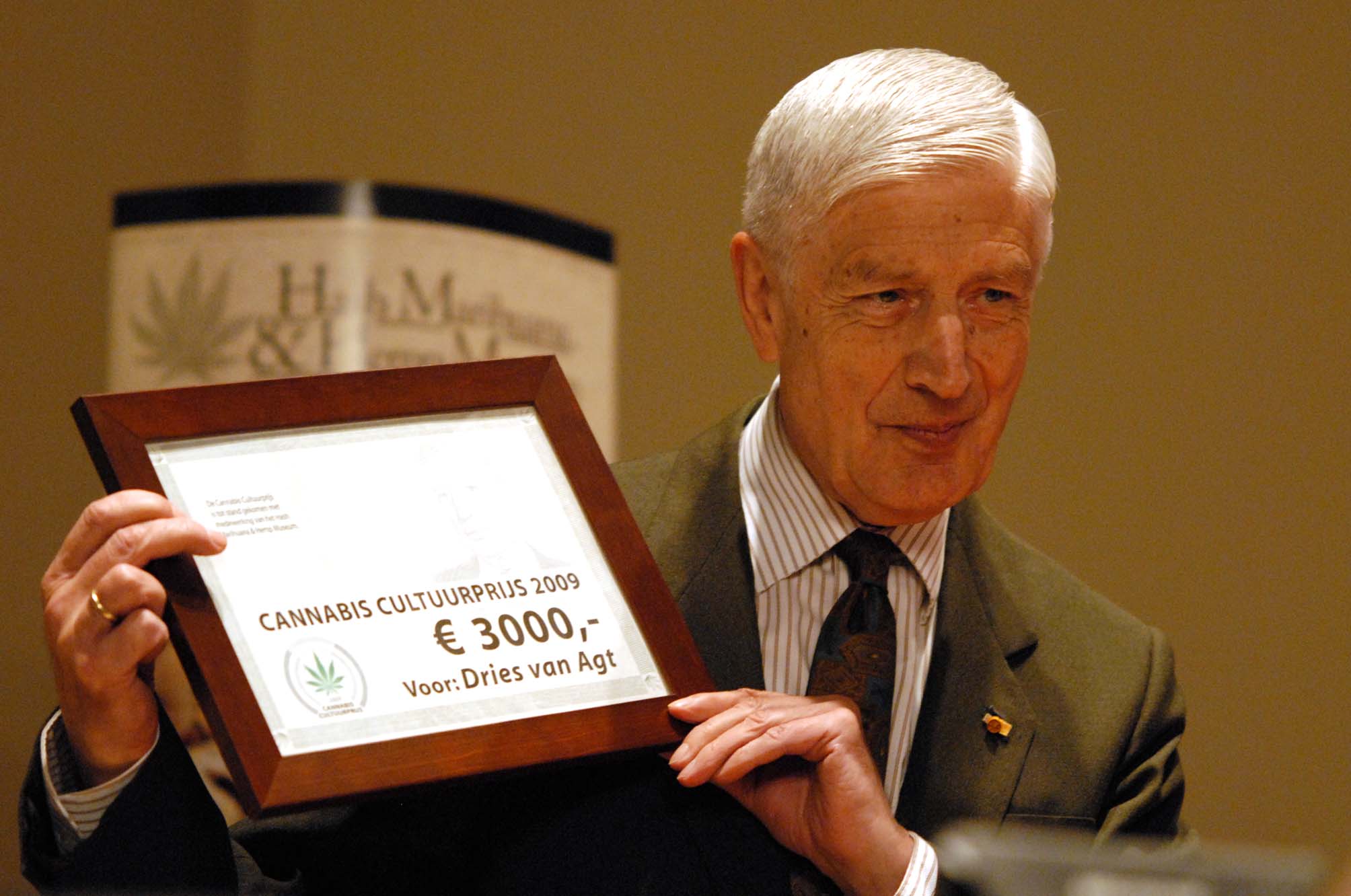
Cannabis Cultuurprijs (cannabis culture award)

ccp2009en1

The Cannabis Cultuurprijs 2009, now in its sixth year, is presented to individuals who have made significant contributions towards the acceptance of cannabis in all its forms and to the reintegration of marihuana and hemp culture into modern society.

At a time when ‘zero tolerance’ is replacing the ‘tolerance policy’ it is more important than ever to acknowledge those who have made a genuine difference to the perception and use of this unfairly maligned plant.

Though other prizes exist in the sphere of cannabis and hemp, only the Cannabis Cultuurprijs celebrates improvements to quality of life and knowledge in quite this way.

The prize itself promotes the achievements of the winner: a unique exhibit dedicated to each one is created for public viewing. Displays honoring previous winners Jack Herer and Ed Rosenthal are on show in the Hash Marihuana & Hemp Museum. Last year’s winner, the late Simon Vinkenoog, is represented in the Hemp Gallery.

A monetary award of ?3000 is also presented. The prize is annually awarded in November. It is independently funded and therefore free from political influence.

18 negative effects of the ban on cannabis

Negative effects Cannabis prohabition

Here is a list of some of the negative effects of the ban on cannabis:

  1. The ban on cannabis means that in addition to the coffeeshops and people who grow for their own use, an illegal market in cannabis also exists. There is no possibility of control over this illegal market which leads to criminality, unsafe situations, and events that disturb the peace; and to which underage people have easy access.
  2. The ban on cannabis makes large scale crops and export of the product into a lucrative source of income for criminal organizations which can then use this income for other criminal activities, or ‘wash’ it via money laundering operations that can disturb the legal economy.
  3. The ban on cannabis encourages criminal and antisocial behavior: rules concerning safety and security (for growing and in the marketplace) are easily broken and this goes unpunished. Conflicts are resolved using violence.
  4. The ban on cannabis leads to an increase in prices, as the producer in an illegal market calculates their risk into the price.
  5. The ban leads to a migration of tourists to coffeeshops near the borders of the country, and the operation of ‘drug runners’ to transport the product. Simple solutions for this problem such as the proposal for a so-called ‘Weed Boulevard’ with legal supply logistics are held back by the ban on cannabis.
  6. The ban on cannabis puts enormous pressure on the resources of the police and the justice system, which cannot then devote them to other, more important goals. Some of the methods used to enforce the ban limit the personal freedom of civilians and are a matter of contention in court.
  7. The costs of enforcing the ban on cannabis are not justified by the results. Although the goal of the ban (an essential reduction in supply and demand) fails to come a single step closer, the ban itself is never brought forward for discussion.
  8. The ban on cannabis damages the credibility of the government, given that the use of cannabis continues to be firmly naturalized in society.
  9. The (world-wide) ban on cannabis is one of the pillars of the U.S. dominated War On Drugs, which has led to sizeable global violations of human rights; and severely damages both the environment, and the security of the populations of cannabis-producing lands.
  10. The ban on cannabis impedes the development of the industrial applications of the plant, which is capable of making a very valuable contribution to a sustainable future.
  11. The ban on cannabis makes it impossible to carry out standardized controls on the product. Therefore demands can hardly be placed on the product in terms of consistent quality, health, or accompanying information on the contents and effects of the product.
  12. The ban on cannabis leads to unwelcome and unhealthy practices in production which negatively affect the quality and effects of the product, and thereby damage the health of the consumer.
  13. The ban on cannabis criminalizes the cannabis consumer (over one million Dutch people), with negative social consequences for the people in question, their relationships, their family, and their home and work environment.
  14. The ban on cannabis is a restriction of the right to freedom of expression. It legitimizes information about the supposed evils of cannabis, information that cannot be seriously tested for durability, credibility or truthfulness and yet is used as justification for the active enforcement of the ban.
  15. The ban on cannabis damages the right of the individual to make decisions about his / her own body.
  16. The ban on cannabis damages the right of the individual to possess a medicine that is necessary to maintain or support his or her health and wellbeing.
  17. The ban on cannabis dissuades doctors from prescribing it to patients who could benefit from the effects; and delays the process of recognition of its medicinal applications in the treatment of multiple afflictions such as HIV and AIDS, Multiple Sclerosis, cancer, and chronic pain.
  18. The ban on cannabis denies the government the possibility of levying taxes on the product.

Source: hashmuseum.com/cannabis-cultuurprijs/

Posted in Quotes & Opinions, Society and Cannabis Tagged: cannabis, cannabis cultuurprijs, criminal organizations, Legalisation, medical, prohabition, top 18, war on drugs

Chairman Of British Advisory Drug Council Got Sacked

cannabis drug advisory council evidende disregardedLast week we talked about Professor David Nutt, the (former) chairman of the Britisch Advisory Council on the Misuse of Drugs. He accused ex-Home Secretary Jacqui Smith of “devaluing” scientific research and making an “artificial” separation of alcohol and tobacco from illegal drugs.

Professor Nutt used a lecture at King’s College in London and a briefing paper to attack the way British politicians ignore scientific evidence and the contradictory and incoherent nature of the U.K’s current drug policy.

Alan Johnson, the current British home secretary, has asked Professor Nutt to resign because his comments “damage efforts to give the public clear messages about the dangers of drugs”.

We feel the message David Nutt was trying to get across couldn’t be any clearer. Some of the most harmful drugs are legal, while other less harmful drugs are illegal. How is this not clear, Mr Johnson?

Anger over the “disgraceful” decision by the Home Secretary, Alan Johnson, to remove Professor David Nutt could lead to a meltdown in the 40-year-old organisation. As many as six of its scientists may resign from the independent organisation, putting further pressure on the Government over its handling of the affair.

The row has wider ramifications for the relationship between politicians and scientists, many of whom are concerned at Mr Johnson’s reaction to Professor Nutt’s comments. Dr King said: “Academics, medics and others are going to ask themselves if they want to serve on these agencies without payment, on their own time and expense, when the advice that they produce is routinely ignored.”

Dr Les King, a respected chemist and former head of the Drugs Intelligence Unit in the Forensic Science Service, said; “What we say is objective and evidence-based. Sometimes people do not want to hear that. The Government has a statutory obligation to consult the council before it makes any changes to the classification of drugs – the Misuse of Drugs Act is clear about that. If significant figures resign, it cannot function any more, and without a change to the Act of Parliament the Government cannot make any changes.” Members of the council, which meets twice a year, are due to gather again on 10 November, when discussions will be dominated by Professor Nutt’s sacking. But the resignations are likely to occur sooner, said Dr King.

Read the full article on independent.co.uk

Posted in Cannabis News Tagged: Alan Johnson, Chairman, David Nutt, Drug Council, drug policy, King’s College, Misuse of Drugs Act, politicians, Professor, Sacked